
Pusoy Dos Rules: PlayFaceToFace’s Public Version
Read the deal, suits, legal hands, special straights and pass resets in PlayFaceToFace’s documented Pusoy Dos house rules, with original card examples.
Mesa Tala Editorial Desk · Updated 5 November 2026 · Published 5 November 2026Pusoy Dos is a climbing card game: a play must beat the cards currently on the table, and the first player to empty their hand wins the round. This reference follows PlayFaceToFace’s own Philippines rules as publicly documented on 5 November 2026. Its visual guide and separate card-ranking reference agree on the rules they both describe, including diamonds-high suits and two special straight patterns. [1][2]
Begin with thirteen cards and the three of clubs
The documented game has four players and one standard fifty-two-card deck without jokers. The whole deck is distributed, leaving thirteen cards in each hand. There is no undealt stock to draw from during the round. Progress comes from playing cards from the hand, rather than replacing a discard from a central supply. [1]
For the first game, the player holding the three of clubs opens. Their opening combination must contain that card. It may be the three of clubs alone, a pair of threes, three threes, or a legal five-card combination containing it. The opening player cannot pass instead of making that required first play. [1]
A later game has a different opening condition. The previous winner leads and may start with any legal combination. The three-of-clubs requirement belongs to the first game; carrying it into every subsequent opening would change the published rule. [1]
Recognise the four permitted play sizes
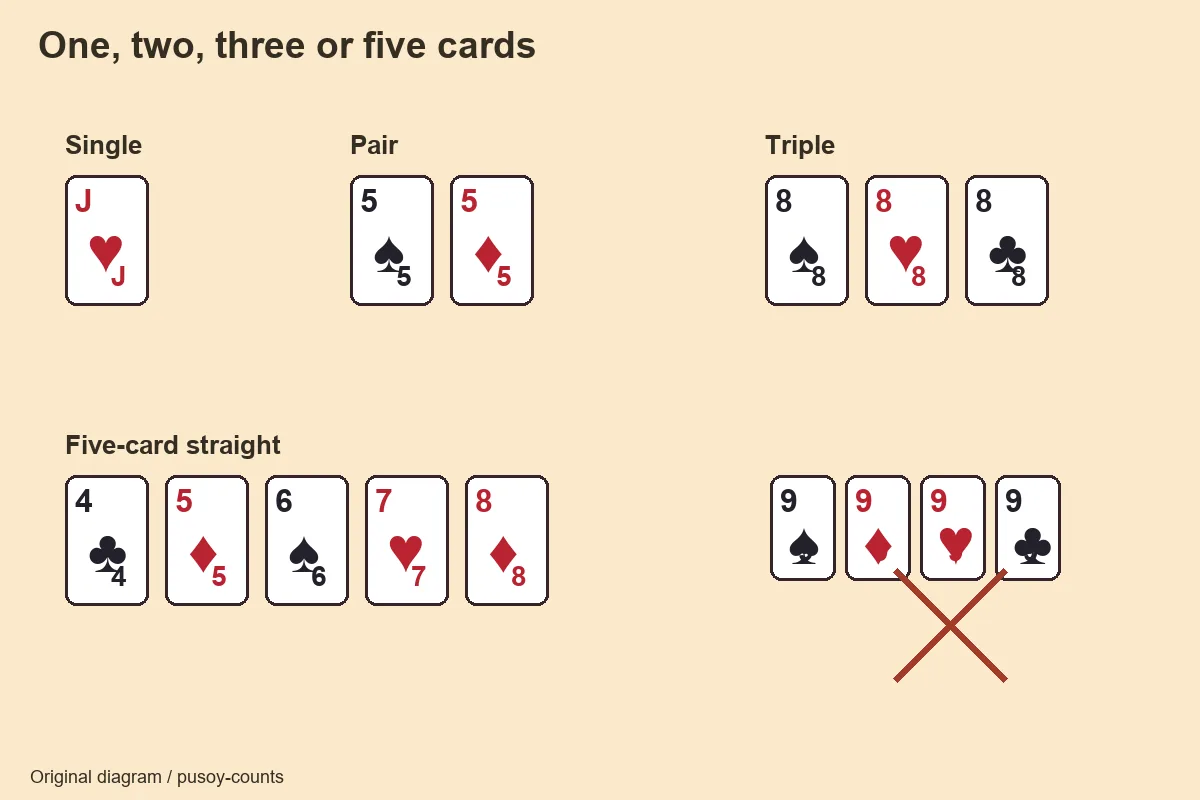
Every play contains one, two, three or five cards. A single is one card. A pair consists of two cards sharing a rank, while a triple has three cards of one rank. Two unrelated cards do not become a legal pair merely because they have the same colour or suit. [1][2]
Five-card plays belong to the categories described below. Four matching cards need an additional fifth card to form the four-of-a-kind category. They cannot be submitted as a standalone four-card play. In this publisher’s Pusoy Dos rules, four of a kind is not a bomb that overrides a single or pair. [1]
The first illustration separates these sizes: a jack, two fives, three eights and a five-card straight. Its crossed-out group of four nines shows the missing fifth-card problem. The examples identify legal shapes; they do not suggest an order in which a person should use their hand.
Compare rank before using the suit order
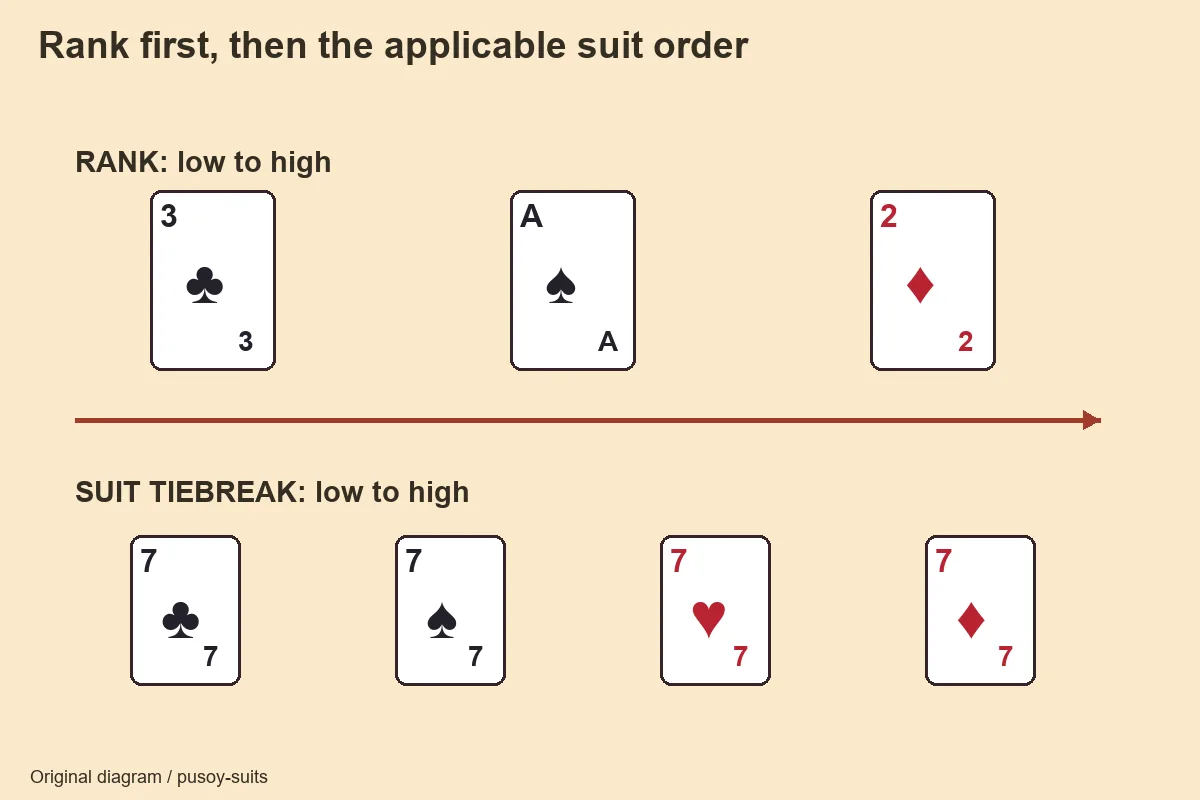
For ordinary card comparisons, the rank order rises from three through four, five, six, seven, eight, nine, ten, jack, queen, king and ace to two. The two is therefore higher than the ace. A king is higher than a queen regardless of their suits, because suit does not reverse a difference in rank. [1][2]
When equal ranks need a suit comparison, the order rises from clubs through spades and hearts to diamonds. Among the four sevens, the seven of diamonds is highest and the seven of clubs lowest. The second illustration presents those equal-rank cards beneath a separate rank rail, keeping the two comparisons distinct. [1][2]
Pairs also compare rank first. A pair of nines beats a pair of fives. Between equal-rank pairs, the pair containing the higher suit wins: seven of spades with seven of diamonds beats seven of clubs with seven of hearts. Triples compare their shared rank; the guide does not use suits to decide a triple comparison. [1][2]
Answer the current play with the same card count
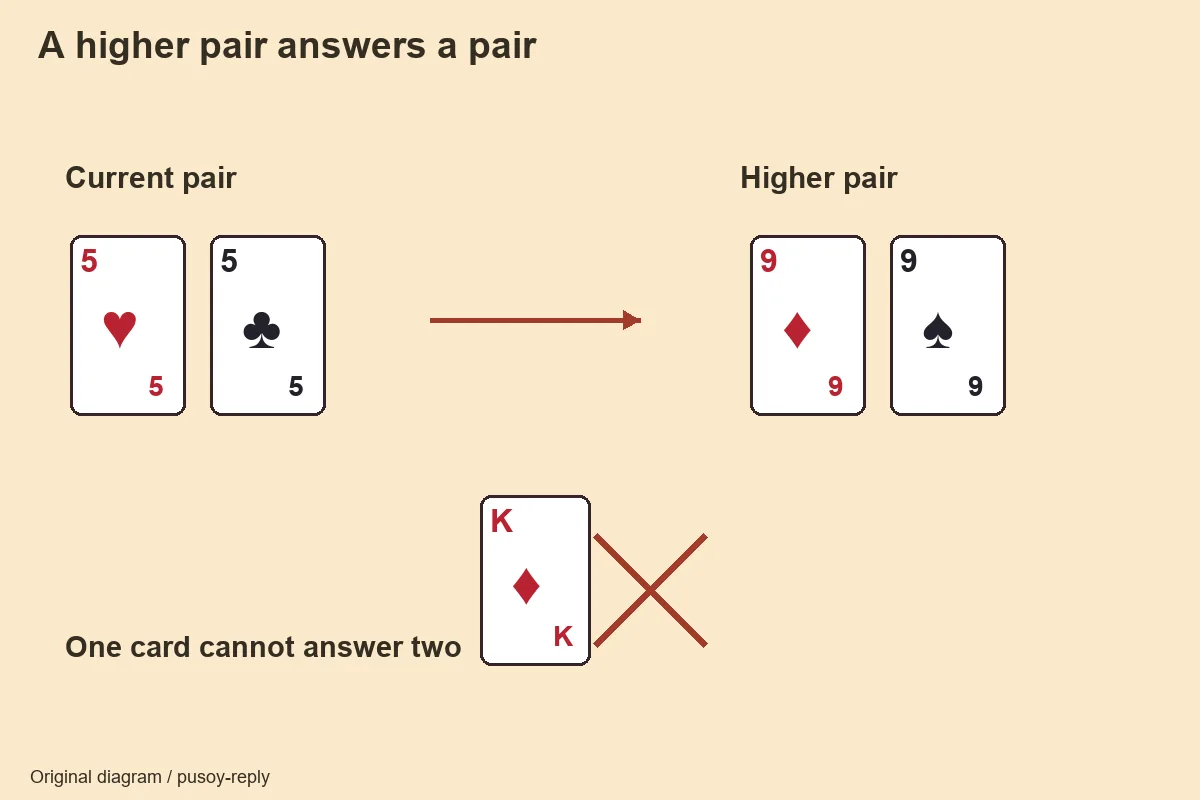
A response must be stronger and contain the same number of cards as the current play. A high single cannot answer a pair. Similarly, an impressive five-card combination cannot be inserted as an answer to a triple. Strength becomes relevant only after the required play size has been satisfied. [1][2]
The reply illustration makes this concrete. Two nines can answer two fives because both plays are pairs and the new rank is higher. The isolated king cannot answer those fives: it supplies only one card. Its rank does not repair that size mismatch.
For five-card replies, equal size does not mean equal category. A flush may answer a straight because both contain five cards and the flush is the stronger category. The same principle does not permit a flush to answer a pair. [1][2]
Read five-card categories from straight to straight flush
The five-card hierarchy rises through straight, flush, full house, four of a kind with a fifth card, and straight flush. A higher category beats a lower category even when the lower category contains individually high cards. Five-card categories are therefore assessed before their internal rank comparison. [1][2]
A straight has five consecutive ranks. A flush has five cards of one suit without forming a straight flush. A full house combines a triple and a pair. Four of a kind has all four cards of one rank plus another card, and a straight flush combines consecutive ranks with a single suit. [1][2]
Full houses compare the triple, not the pair. Three eights with two threes beats three sevens with two aces. The aces do not outweigh the lower triple. Four-of-a-kind hands likewise compare the four matching cards: four kings outrank four queens, whatever fifth cards accompany them. [1][2]
Keep the two special straights in their documented order
PlayFaceToFace accepts ace-two-three-four-five and two-three-four-five-six as special straights. In its published rules, ace-two-three-four-five is the highest straight, with two-three-four-five-six next. Both sit above ordinary ten-jack-queen-king-ace. [1][2]
This does not allow every sequence containing a two. Jack-queen-king-ace-two is expressly invalid as a straight, and the guide also rejects queen-king-ace-two-three. A sequence cannot be extended around the ranks simply because one of the two named exceptions is allowed. [1][2]
Ordinary straights compare their highest card, then that card’s suit when needed. The special patterns must first retain their published priority. These details are specific to this house-rules snapshot; a differently ordered wrapping-straight rule from another publisher is not a substitute. [1][2]
Apply the default suit-first comparison to flushes
The documented default compares flushes by suit first, then by the highest card within the flush. A diamond flush therefore beats a heart flush even if the heart flush has a higher individual card. This differs from comparing only the largest rank at the start. [1][2]
For example, a diamond flush containing three, five, seven, nine and jack beats a heart flush containing four, six, eight, ten and king under that default. Neither example is a straight flush. The higher heart king does not reverse the suit-first decision. Both official documents note a highest-card-first option for private rooms; that option is outside this default-rules explanation. [1][2]
Separate passing from clearing the table
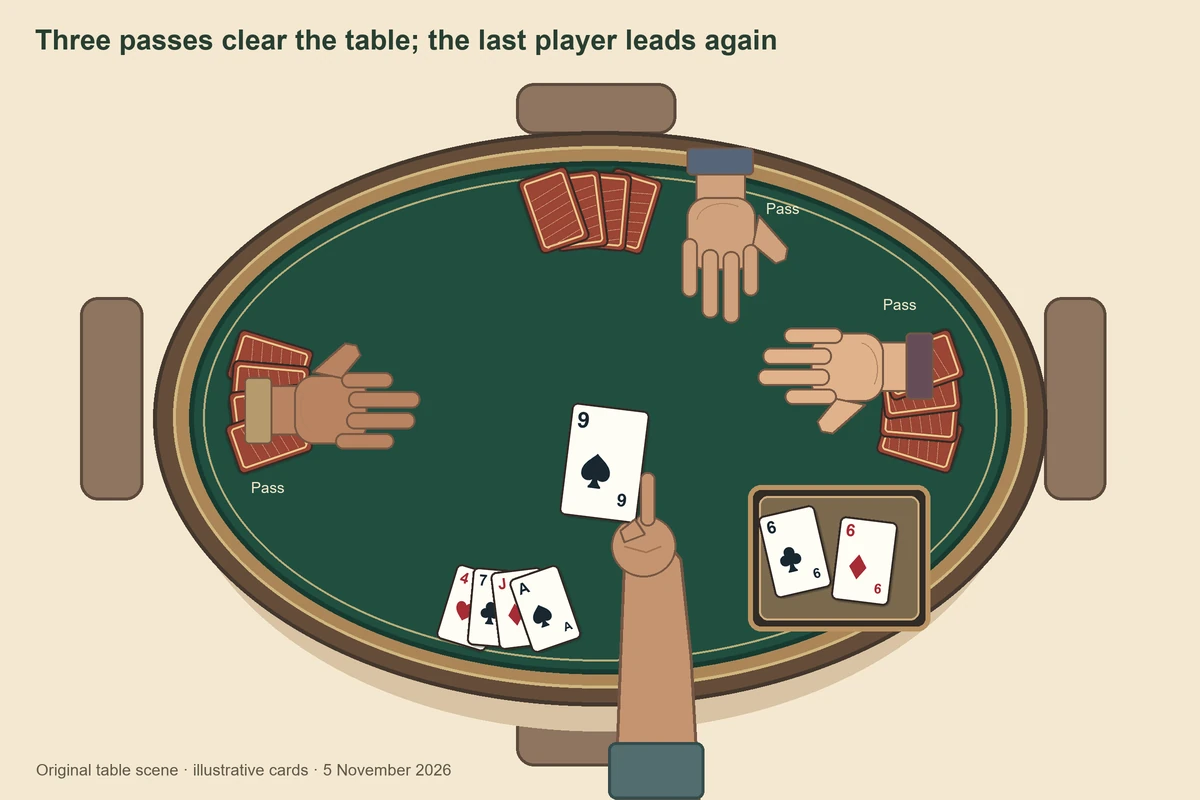
A pass skips the current turn without permanently removing the player from that climb. If another player raises the table and the turn later returns, a previous passer may make a legal stronger response. Passing is therefore different from being excluded until the next lead. [1]
Three consecutive passes clear the current table. The person who last played a valid combination then leads afresh and may choose any legal size. In the reset illustration, the six of clubs and six of diamonds lie in a discard tray beside a four-seat felt table. Three open palms indicate passes, while the previous leader places a nine of spades as a fresh single. The remaining hands are still present; nobody has emptied their hand. [1]
A new valid play interrupts a sequence of passes. Suppose one player passes after a pair of fives, but the next player supplies a higher pair. The earlier pass cannot be combined with two later passes as though no new play occurred. The clearing condition concerns consecutive passes after the current valid play. [1]
End the round when one hand becomes empty
The round stops as soon as one player plays their last card. That person wins; the others count the cards remaining in their hands, with fewer remaining cards giving a lower score. This is the publisher’s non-monetary round-count description. It does not introduce a currency value or a payment calculation. [1]
If three other players finish with three, seven and ten cards respectively, their remaining-card counts are three, seven and ten. Ten remains a count of ten cards in this example; it is not silently converted into a doubled penalty. The previous winner’s right to open the next game remains distinct from a three-pass table reset within the current round. [1]
Questions about this version
Which Pusoy Dos rules does this article use?
PlayFaceToFace’s public default Philippines rules snapshot retrieved on 5 November 2026. The two technical pages carry the same production generation, but no semantic rulebook edition number is supplied. This is not a claim about every local table or an app we tested.
Can a player return after passing?
Yes. The full guide says a pass skips that turn rather than excluding the player from the entire climb. Three consecutive passes clear the table and let the last valid player lead again.
Which special straight is highest in this version?
The publisher places ace-two-three-four-five first and two-three-four-five-six next. Both technical documents state this order. Jack-queen-king-ace-two is not a legal straight in this version.
Does the three of clubs open every game?
No. It must be included in the first game’s opening play. The previous winner opens the next game and can lead any legal play.
Are the illustrations records of played rounds?
No. Three original card diagrams were created on 3 November 2026; the four-seat reset scene was created on 5 November 2026. All are non-monetary illustrations. No account, client, app or round was tested for this article.
How we checked this reference
We retrieved the production Pusoy Dos guide and separate ranking reference on 5 November 2026, then compared their overlapping rank, suit, hand-category, flush and special-straight rules. The guide supplies pass, reset and round-end details. Original HTML bytes, source dates and the shared production-generation marker are archived. We did not install an app, start a round or infer server behaviour. The source scope and manuscript received separate editorial review before publication.
Version pin: production-20261103T101626Z-05dc55d8. No semantic rules-edition number is supplied.
Responsible gaming
For adults aged 21 and above. These card examples require no stakes, account or payment. Keep essential living money protected and seek support when gambling causes harm. Mesa Tala is an editorial project and does not claim a gambling licence. Verify an operator’s exact entity and domain against current official PAGCOR records; a rules article does not establish permission.
PAGCOR responsible-gaming support · PAGCOR official licensing and registered-domain records
Official technical sources
- How to play Pusoy Dos: a visual guide — publisher update 2026-10-13; retrieved 2026-11-05. Own default Philippines rules; production snapshot pinned in the evidence bundle.
- Big Two and Pusoy Dos card ranking: cards, suits and five-card hands — publisher update 2026-10-30; retrieved 2026-11-05. Own default Philippines rules; production snapshot pinned in the evidence bundle.