
Tongits Score Sheet: A Blank Printable Record
By Mesa Tala Editorial Desk · Revised 5 November 2026 · Published 5 November 2026A Tongits score sheet can record the point subtotal of selected leftover cards without deciding who won a game. This original blank worksheet uses the card values and valid-group concepts shared by Cardems’ published Tongits guide and its pinned public browser implementation. Classify the cards first, then record their identities and add only the cards selected for the subtotal. [1][2]
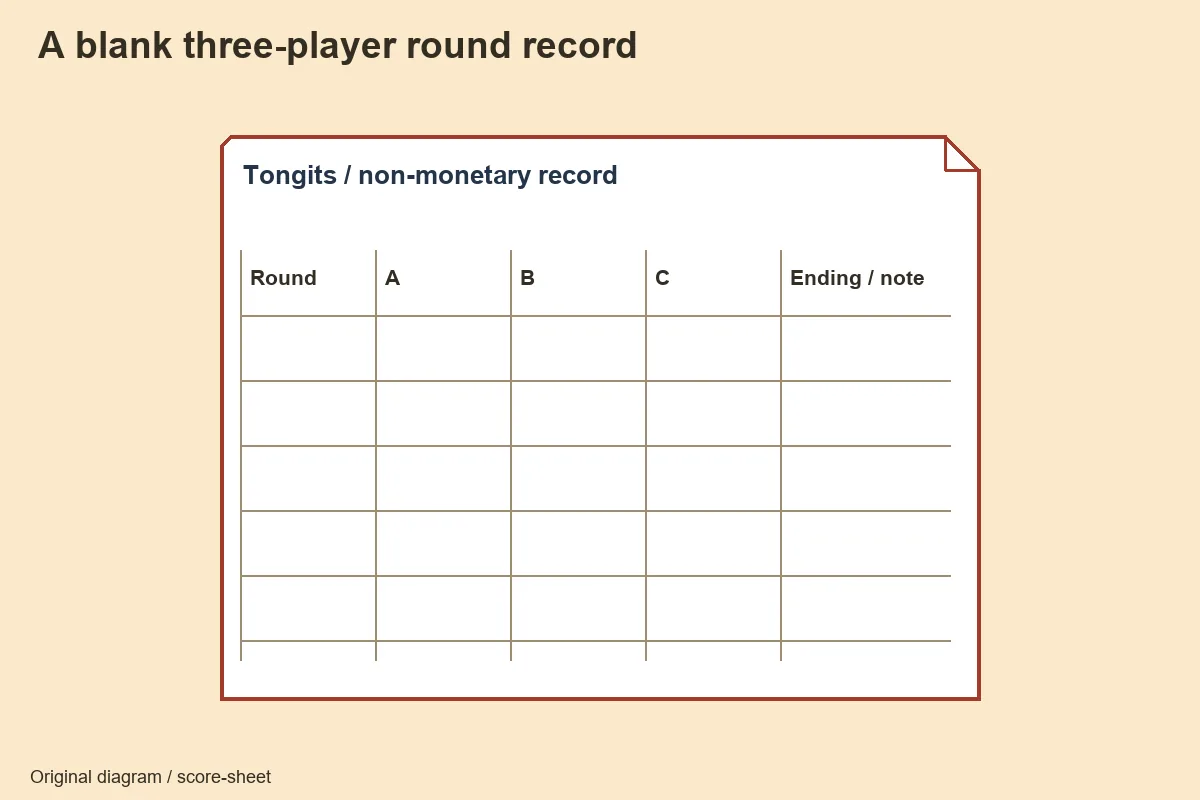
Blank record files
The original editorial form records point subtotals only. No account or payment information is needed.
Establish what each row records
One row should describe one identified set of cards at one chosen moment. Use neutral labels A, B and C for the three columns, record the date, and name the rule reference in the space provided. A row number helps locate a note later; it is not an instruction to combine unrelated snapshots into one total.
Write a short description of the selected cards beside the subtotal or in the correction-note area. For example, “ace of clubs, four of diamonds, queen of hearts” is more useful than the unexplained number fifteen. The identities allow another reader to check both the classification and the addition. They also prevent a later photograph of different cards from silently becoming the evidence for the same cell.
The blank form has an optional context column labelled Ending. For this worksheet, leave it blank or use a neutral existing label solely to identify the record. The column supplies no rule decision. The useful calculation remains the identified card subset and its point sum; the form contains no hidden formula or automatic result selector.
Classify valid groups before selecting the leftovers
Cardems describes sets of three or four cards of the same rank and runs of at least three consecutive cards in one suit. Its public browser logic validates these groups and distinguishes them from the remaining cards used in its deadwood calculation. Aces are low in the documented run convention. [1][2]
For a non-monetary example, put an eight of clubs, eight of diamonds and eight of hearts together as a valid set. Place an ace of spades, four of clubs and queen of diamonds beside that set. The set and the three other cards are different categories in the exercise. If the selected leftover subset consists of the ace, four and queen, those three cards are the inputs to the subtotal; the three eights are not added again merely because they remain visible on the paper.
Groups must also use distinct physical cards. A four-five-six-seven run of hearts can be treated as one consecutive group. It cannot simultaneously be counted as two separate groups using the same five and six twice. The pinned implementation searches for non-overlapping valid groups when calculating its private-hand deadwood value. The worksheet does not perform that search for the reader. [2]
Where several classifications appear possible, preserve the card identities and the proposed group boundaries before writing a final number. Mark a classification question separately from an arithmetic error. A tidy sum cannot resolve an uncertain input set, and an empty subtotal cell is preferable to a number based on cards that have not yet been identified.
Calculate a card subtotal from the named values
The two Cardems materials agree on the values used here: an ace contributes one point, numbered ranks two through ten contribute their face value, and a jack, queen or king contributes ten points. These are card-point values within this defined reference, not amounts of money. [1][2]
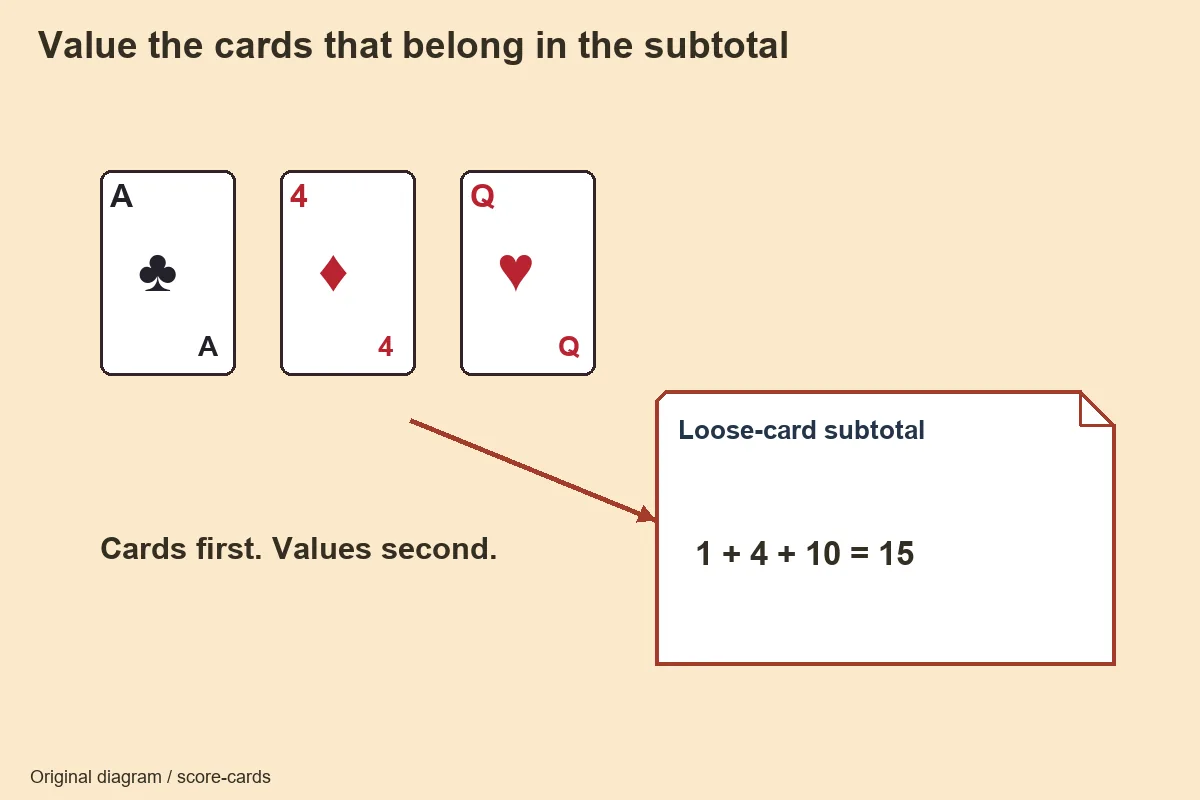
The card illustration shows an ace, a four and a queen beside the calculation one plus four plus ten equals fifteen. Treat them as the selected leftovers for that invented exercise. The queen contributes ten, rather than its rank position of twelve or a value of thirteen. Writing the three terms before the total makes that distinction visible.
A second example can use a two, a five and a jack: two plus five plus ten equals seventeen. A third can use a three, a six and a king: three plus six plus ten equals nineteen. These are separate arithmetic examples. They do not describe three opponents’ observed hands, and the different totals are not ranked into a result.
Check the list length as well as the addition. If the record names three cards, the calculation should contain three contributions. A missing contribution can leave a plausible-looking number even when every included term has the correct value. Crossing off each named card while checking a paper example is a simple way to confirm that every selected input appears once.
Preserve a correction instead of hiding the old entry
A useful correction retains the original entry, the revised value and the reason for the change. The handwritten illustration shows eighteen crossed out and fifteen written beside it in the same Round 2/B cell with initials. The accompanying note says the queen counts ten rather than thirteen. This is an invented correction example, not a captured player record.
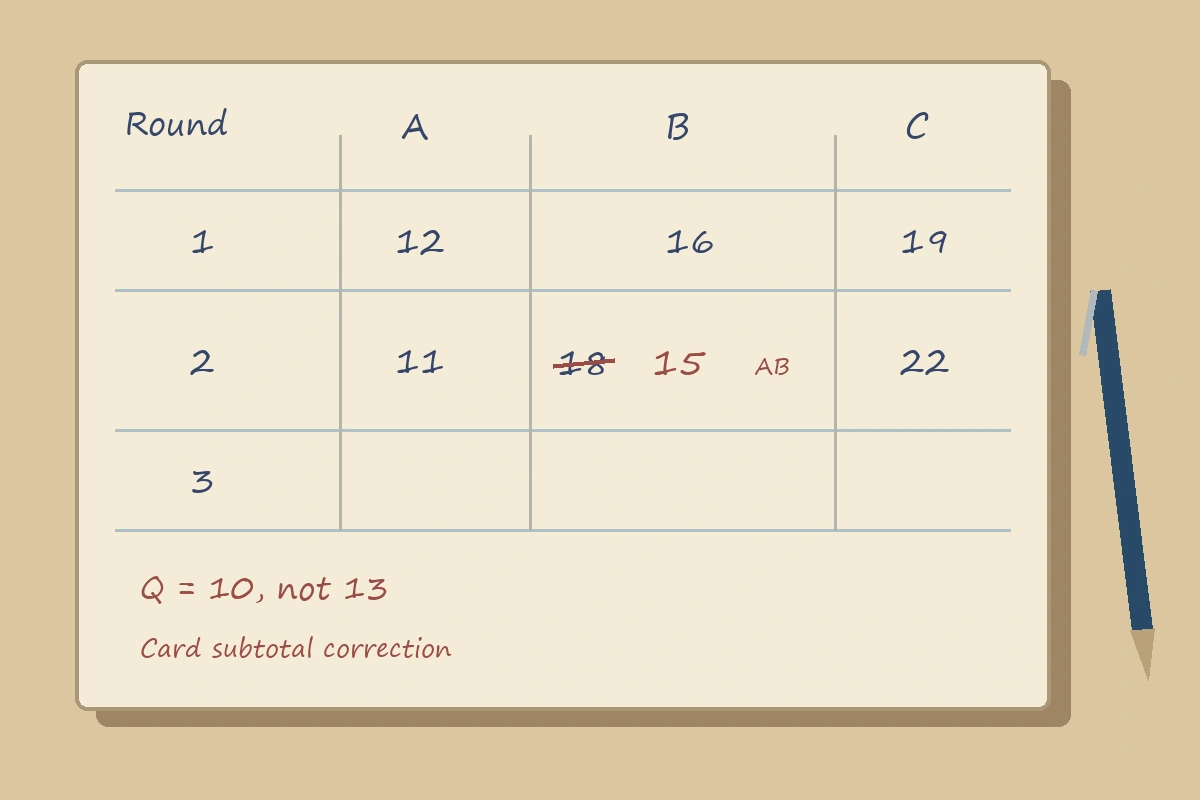
Its arithmetic is traceable: one plus four plus thirteen would have produced the incorrect eighteen; replacing the incorrect queen contribution with ten gives fifteen. The source-based card-value rule supplies the correction, while the handwriting simply preserves how the example changed. No rule is inferred from the initials or the appearance of the notebook. [1][2]
Use one readable strike-through so the old number remains visible. Put the new number alongside it, and add a brief explanation such as “queen value corrected.” If the wrong card identity was recorded, correct that identity before recomputing the subtotal. Otherwise, a mathematically correct sum could still refer to the wrong inputs.
When copying a paper record into a digital document, preserve a note that a correction was made. A transcription that silently replaces eighteen with fifteen removes information another reader may need. Keep the original paper privately when appropriate, and share only the small excerpt necessary to understand the correction.
Keep classification notes separate from running totals
A selected-card subtotal and an accumulated column total answer different questions. The first describes the identified cards in a particular row; the second would combine numbers from several records. This blank worksheet does not impose an accumulated target. If a reader creates a separate running total for a classroom exercise, its meaning should be written beside it rather than assumed.
Likewise, changing a card’s category is different from changing its value. Moving a card from the selected leftover list into a documented valid group changes which inputs belong in the subtotal. It does not turn an ace into a different point value or convert a queen into its ordinal rank. Record the classification change explicitly so the later sum can be checked.
Keep money columns, conversion rates and payment instructions off this sheet. The supplied form is an editorial record aid. Its empty spaces are intended for card descriptions, point subtotals and explanatory notes, not for reconstructing an account balance from a game's imagery.
Print a legible blank master and minimise personal details
The companion HTML and PDF provide the same blank record structure. Use the browser’s print preview for the HTML or open the supplied PDF, then check that the A, B and C headings and note column remain on the same page as the rows. A readable master copy is more useful than a smaller print that clips its final column.
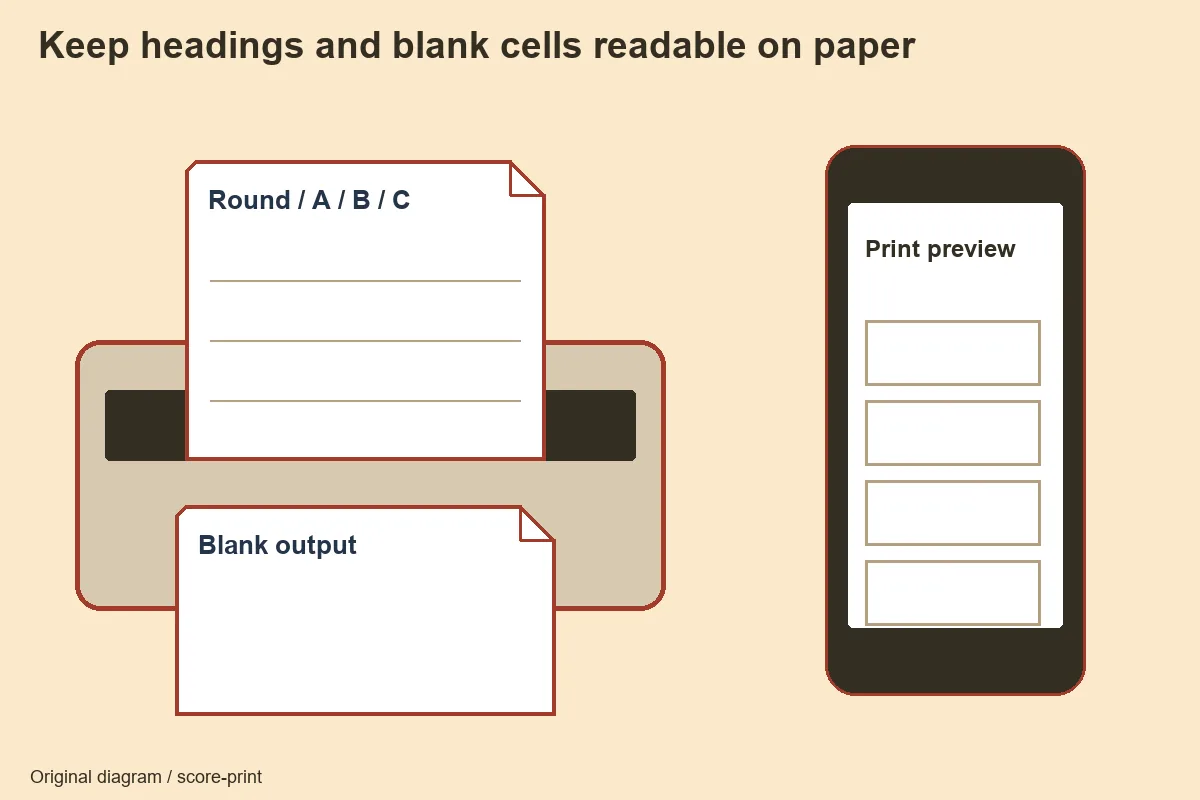
Use a separate copy for each exercise. Previous initials, overwritten totals or unrelated notes can otherwise become confused with the current card list. A date and neutral participant labels are enough for a paper learning record; there is no need to enter a game-account name, phone number, wallet reference or full legal identity.
The printer illustration shows a blank page and a phone preview rather than a completed financial record. Its purpose is to make the layout check concrete: the headings, rows and writing space need to stay readable. After printing, identify the selected cards, preserve the grouping note and leave a subtotal unresolved whenever those inputs are not yet clear.
Questions about this worksheet
Is this an official Cardems score sheet?
No. It is an original editorial worksheet. The two official materials support the scoped card values and valid-group/deadwood concepts, not the design of this form.
Why not add every visible card immediately?
Classify valid groups and identify the selected leftover subset first. The pinned browser implementation uses non-overlapping groups when calculating deadwood, so cards in those groups are not blindly counted again.
What is the ace-four-queen example total?
For the selected leftover cards, the values are one, four and ten, totalling fifteen. This is an invented card-point example with no monetary conversion.
Does the smallest subtotal identify a winner?
The worksheet does not make that decision. It records classified card inputs and point subtotals only; eligibility, winners and official settlement are outside its scope.
How we checked this record aid
We statically read Cardems’ named Tongits guide and the active public browser implementation retrieved on 5 November 2026. The preserved HTML-to-loader-to-TongitsGame chain and exact source hashes identify the snapshot. Functions b, F and ea were checked for valid groups, non-overlapping deadwood selection and card values; no game code was executed or round played. An independent source gate accepted only these consistent subtotal concepts. Broader rule eligibility and settlement are excluded, and this original form is not a supplier template.
21+ and responsible gaming
For adults 21+ only. A card-point record cannot make gambling a source of income or protect essential funds. Keep money needed for living costs separate and seek support if gambling affects wellbeing. Check an operator’s exact name and registered domain in PAGCOR’s own records; this editorial project does not claim a gambling licence.
PAGCOR responsible-gaming information · PAGCOR official regulatory records
Official technical sources
- Cardems — Tongits rules, melds and deadwood card values — retrieved 2026-11-05. Guide last updated 29 August 2026.
- Cardems — pinned Tongits browser implementation, rules module 57767 — retrieved 2026-11-05. Active browser artifact pinned by SHA256 in the evidence manifest; static inspection only.